Donnie Humphrey
Class of 2026
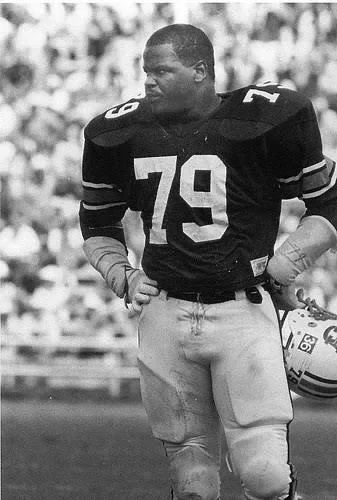
A cold, cloudy October Saturday on The Plains. The crowd and the Auburn offense equally lackluster and silent. Gwen Humphrey was a freshman basketball player at Mississippi State and attending the game, in which her brother Donnie was a defensive lineman for Auburn.
“He was in his senior year,” Gwen recalls, “so I don’t know why he felt like that, but he was just going to try to demolish the Bulldogs. I have never seen Donnie hit that hard in a game. I mean, it was like he was on a mission. That’s my little sister (at Mississippi State) and I’m here to represent.”
Maybe it was a protective big brother sending a message with his seven tackles and offense-clogging presence on the front line … or as non-relatives might suggest, just another typical imposing performance for the 6-3, 280-pound enforcer.
Humphrey, who died in 2014 at age 53, was a five-year football letterman at Auburn following his All-State career at J.O. Johnson. He was named All-America and a member of Auburn’s All-Centennial team. He led the defense on Auburn’s 1983 SEC championship team, winning the school’s first title since 1957.
“Donnie Humphrey was a guy on our football team that everybody loved,” Pat Dye told reporter Phillip Marshall for a 1994 story.
His Auburn days were interrupted by a knee injury in what was going to be his senior season, sending him off into a redshirt year, but a return the next year for his spectacular run and the Tigers’ title. He was drafted in the third round by the Packers, with NFL teams looking at his knee with caution, and spent three seasons in Green Bay, starting at defensive end every game of his rookie season.
Nelson Mandela once said, “Do not judge me by my successes, judge me by how many times I fell down and got back up again.” And, indeed, falls are part and parcel of Donnie Humphrey’s saga – as is his final chapter of getting back up. While in Green Bay, he “put my trust in the wrong kids of people,” he told Marshall for the 1994 story. His life became messy and complicated, as many lives were in those days, wrecked by substance use and abuse. “I was a confused individual. I was lost,” he said. Humphrey served a jail term, which was a pivotal time in turning his life around.
“Even though he had a difficult time in his life at one time, he overcame that, and that did not in any kind of way negate the athlete that Donnie was,” Gwen says.
His long-time friend Ocie Maddox Jr. said at Donnie’s passing, “He was very redepemptive. He knew he made mistakes, and he wanted to make things right.” One avenue for that was coaching. He joined the staff of the Hi-Desert Heat in the National Developmental Pro Football League. Said Maddox, “He told me, ‘I gave my life to God. There are a lot of things I’ve done in life I’m not proud of. But coaching this team and having God in my life has been the ultimate blessing for me.’”
“Donnie was so determined to reform or end the negative image that people had put on him, so he went to California and became a coach,” Gwen says. “He passed away in California, but he was getting ready to move back home.”
Had he returned home, it would have been to a place with a rich legacy in sports and to so many touchstones of his life. Frank and Dorothy Humphrey raised a household of uber-talented athletes, with Gwen having been inducted into this Hall of Fame in 2022, and brothers Frank, Terrance and Clifford were also standouts.
“I'm just so proud that he's finally getting (into the Hall of Fame,” Gwen says, “and it just breaks my heart that he's not here to get it.”