Anthony Jones
Class of 2026
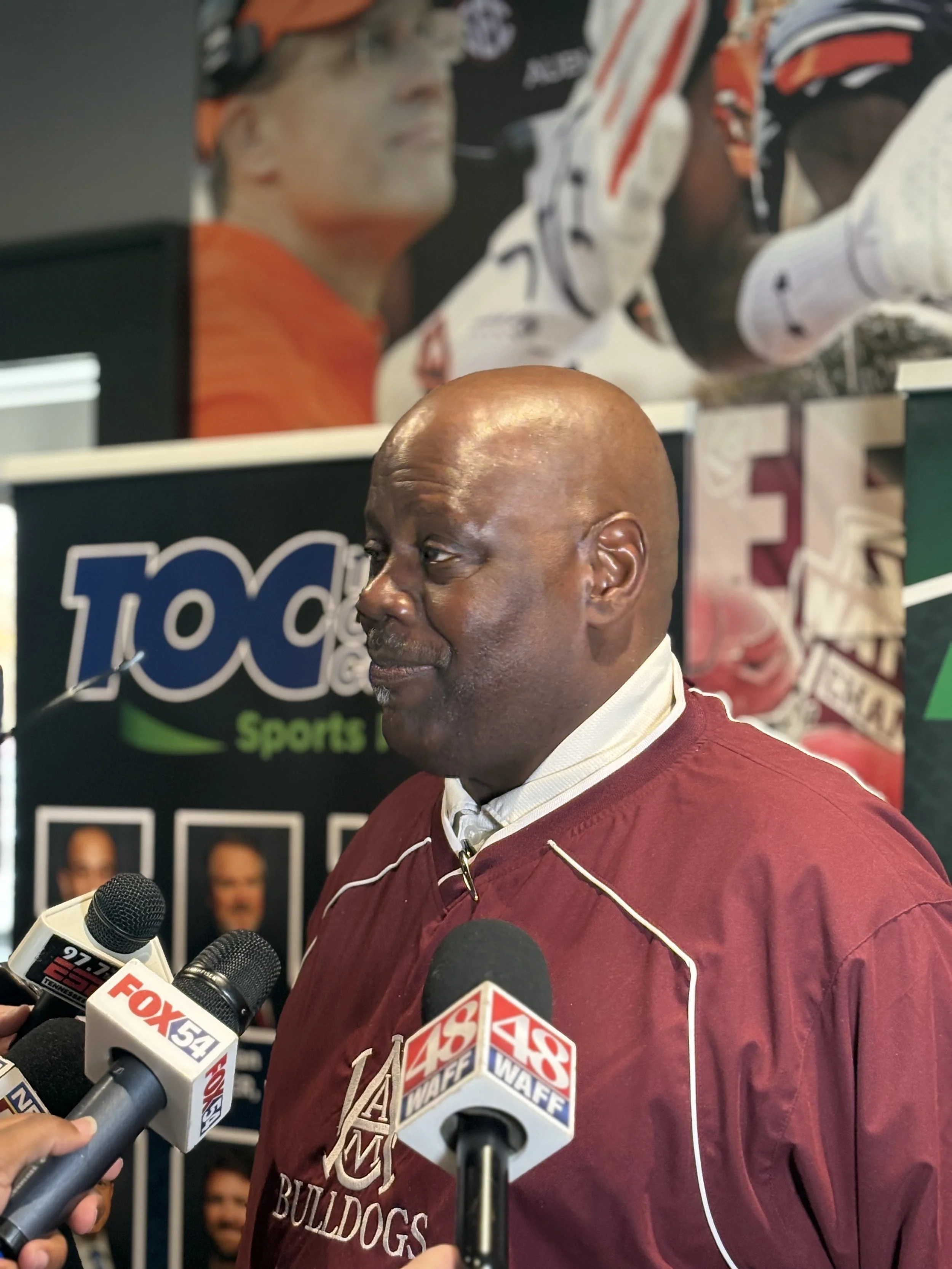
Anthony Jones remembers the conversation as if it happened yesterday.
Jones’ father, Anthony Jones Sr., had been diagnosed with heart failure in the early portion of 1970 and was on the verge of dying. He asked his sons, Anthony and Wayde, who were 10 and 11 years old at the time, to take care of their mother, Shirley. The boys promised their father they would do it.
However, they had no idea how they were going to do it. That’s when Jones’ godfather, Raymond Puryear, came up with a great idea.
“He told me to get a football scholarship,” Jones recalled.
That advice stuck with Jones and led him to a career he never imagined.
Jones played football for 11 years, two in high school, four in college and five in the National Football League. He coached for 30 years, 11 years as an assistant coach and 19 years as a head coach.
Combined, Jones spent more than 40 years in football as a player, an assistant coach and a head coach. And, as a result of that, Jones is being inducted into the Class of 2026 Huntsville Madison County Athletic Hall of Fame.
“It’s a tremendous honor,” said Jones, who compiled an 83-57 record in 12 seasons at Alabama A&M, including the school’s first Southwestern Athletic Conference championship in 2006. “It’s a tribute to the way we ran our program. “I met some wonderful people in my 12 years there … players, coaches, support staff and parents. We built some great relationships and some of them still exist today.”
Jones won five SWAC East Division titles and had 82 All-SWAC players. He posted back-to-back nine-win seasons in 2005 and 2006, when he was named SWAC Coach of the Year, and went 8-4 in the Magic City Classic.
His .593 overall winning percentage and his .620 winning percentage in the SWAC while at A&M trails only Ray Greene and Louis Crews, the Bulldogs’ all-time winningest coach. Since Jones’ contract was not renewed following the 2013 season, A&M’s last three coaches – James Spady, Connell Maynor and Sam Shade – have gone a combined 59-70.
Jones’ football journey began at Patterson Senior High School in Baltimore, where he played tight end. He would later earn a scholarship to Maryland State College, which later became the University of Maryland Eastern Shore. After UMES shut down its program, Jones moved on to Wichita State, where he played for Willie Jeffries, the first African American to be a head coach on the NCAA Division I level.
Jones was drafted by the Washington Redskins, where he won a Super Bowl with former Grambling State star Doug Williams, one of his coaching rivals in the SWAC.
After spending five years in the NFL, Jones became a coach and later served as a head coach at Morehouse College, Alabama A&M and Elizabeth City State University.
“I had four pillars of success for my program,” Jones recalled. “The first one is I wanted to recruit the right people. That included staff, trainers and players. Secondly, I wanted to train them. The third pillar was to retain them and the fourth one was to graduate them.
“We had a lot of success and people looked at our players and felt good about them. I run into guys I haven’t seen in 5, 10, 15 years and they say I get it now. I wanted them to learn before they got out the in the real world. I wanted them to create value for themselves.”
After finding success at Morehouse, Jones applied for two jobs … the A&M job and the Howard University job. He had made up his mind he was going to take the first offer. Former A&M athletics director Jim Martin won out. “Coach Martin gave me the support I needed to be successful,” Jones said.
In his 12 years with Bulldogs, A&M advanced to the SWAC championship five times. Unfortunately, Jones and company only came away with the title once, beating the University of Arkansas at Pine Bluff in 2006.
Arguably, one of the most disheartening SWAC championship game losses came in 2011 to Grambling. To this day, that game still haunts Jones.
“We outplayed them in every aspect of the game,” Jones remembered. “They beat us on the scoreboard due to our turnovers. That was my most disappointing loss.”
After that season, Jones said his relationship with A&M soured some. “Some folks got tired of me,” he said.After leaving A&M, Jones said he stayed away from the program. However, after being inducted into the school’s Hall of Fame in 2023, Jones said he felt a sense of renewal.
“I was really heartbroken the way the relationship ended,” he said. “It helped me heal when A&M elected me in the Hall of Fame. I love A&M for giving me a chance to become what I became. I will be forever grateful.”
Jones is also grateful to his family, his two sons Drew and Julian, and wife, Valerie.
“My two sons were my number one fans and were always around my program, learning and providing help and support. Drew my oldest played for me my final season at AAMU and is a graduate of AAMU. My wife gave me the support that I needed and allowed me to do my job and achieve what I achieved as a coach, “ he said.
-- Reggie Benson